How to Calculate W2 Wages From a Paystub (2026 Guide)
By Davis Clarkson , October 7 2026

Here is how to calculate W2 wages from paystub totals: start with year-to-date gross pay and subtract the pre-tax items that each box excludes. The three wage boxes use different rules, so one stub gives three different answers. That holds for salaries and hourly pay alike.
If you run payroll, those answers have to match the W-2s you issue, so every pay stub should be right before January. This guide walks one final stub through each box, with 2026 limits and the checks that catch mistakes.
Key Takeaways
- Box 1 subtracts 401(k) deferrals. Boxes 3 and 5 do not.
- Pre-tax health premiums lower all three boxes.
- Taxes withheld never reduce W-2 wages.
- Box 3 stops at $184,500 in 2026. Box 5 has no cap.
- Worked Example: Calculate W2 Wages From Paystub Totals
- How to Calculate Box 1 on W2
- How to Calculate Social Security Wages From Paystub Totals
- What Is Medicare Wages and Tips on W2?
- Why Is Box 1 and 3 Different on W2?
- State Wages on W2 and Local Wages on W2
- Is a W2 a Pay Stub?
- Calculate W2 Wages From Paystub Records Before You File
Worked Example: Calculate W2 Wages From Paystub Totals
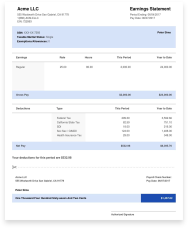
To calculate W2 wages from paystub figures, take a final stub showing $52,000 in YTD gross pay, a 6% pre-tax 401(k) deferral of $3,120 and $2,400 in pre-tax health premiums. Tax withheld on the stub doesn't enter the math, so gross wages are the only starting point. Dependent care FSA deductions would lower the boxes too, but limits vary, so check your plan.
| Stub line | Amount | Box 1 | Box 3 | Box 5 |
|---|---|---|---|---|
| YTD gross pay | $52,000 | $52,000 | $52,000 | $52,000 |
| 401(k) pre-tax | $3,120 | -$3,120 | none | none |
| Health premiums (Section 125) | $2,400 | -$2,400 | -$2,400 | -$2,400 |
| W-2 amount | $46,480 | $49,600 | $49,600 |
Check it: $49,600 x 6.2% is $3,075.20 for Box 4, and $49,600 x 1.45% is $719.20 for Box 6. The $3,120 deferral should also appear in Box 12 with code D.
How to Calculate Box 1 on W2

What is Box 1 on W2? It holds your taxable wages for federal income tax. Start with YTD gross pay and subtract pre-tax 401(k), 403(b) and 457(b) deferrals, plus Section 125 benefits such as health insurance, dental and vision premiums. HSA contributions through payroll also reduce it. The 2026 deferral limit is $24,500.
Retirement plan deferrals count only when they are pre-tax. Add taxable extras, such as group-term life coverage above $50,000 (Box 12, code C). Roth 401(k) deferrals do not lower Box 1, because they are taxed.
How to Calculate Social Security Wages From Paystub Totals
What is social security wages on W2? It is gross pay minus Section 125 deductions only, as our social security wages guide explains. Leave 401(k) deferrals in, because they still face payroll tax. Social Security tips (Box 7) are reported separately. Box 3 stops once earnings reach the 2026 wage base of $184,500, according to the IRS. Employees pay 6.2% Social Security tax on wages up to that cap, and Box 4 should equal Box 3 times 6.2%.
What Is Medicare Wages and Tips on W2?

Medicare wages and tips, in Box 5, use the same base as Box 3, but with no cap. Employees pay 1.45% Medicare tax, and employers withhold an extra 0.9% on wages above $200,000. High earners will therefore see Box 5 exceed Box 3.
Why Is Box 1 and 3 Different on W2?
Retirement deferrals lower income-tax wages but not payroll-tax wages. A 401(k) contribution shrinks Box 1 and leaves Boxes 3 and 5 alone. For top earners the reverse can happen: past $184,500, Box 3 stops growing and may fall below Box 1.
State Wages on W2 and Local Wages on W2
State wages in Box 16 usually match Box 1, though some states tax 401(k) deferrals differently. Box 18 applies only where a city or county taxes income, so it is blank for many employees.
Is a W2 a Pay Stub?
No. A pay stub covers one pay period. A W-2 form is the annual wage summary your employer sends to you and the Social Security Administration. Your final stub helps you check the W-2, but it isn't a substitute. Wages count in the year paid, so a December period paid in January belongs on next year's W-2.
How to Use Your Last Pay Stub as W2
If the form is late, contact your employer first, as you would for a W-2 from a previous employer. The IRS says that if the missing form doesn't arrive in time to file, you may use Form 4852 and estimate wages and withholding. Your last stub's YTD figures give you those estimates. If the real W-2 differs later, you must file Form 1040-X.
How to Estimate Tax Return With Last Pay Stub
Check each wages box on the stub, then take your Box 1 estimate, subtract your standard deduction, and compare the resulting tax to YTD federal withholding on the stub. Withholding above the tax suggests a refund. Confirm your standard deduction at irs.gov first. Treat the result as a rough estimate, and see how adjusted gross income on W-2 fits in.
Calculate W2 Wages From Paystub Records Before You File
Employers should tie out every W-2 to payroll records, not to memory. To calculate W2 wages from paystub records, total each employee's gross pay and confirm the total amount by box, then subtract deferrals and premiums box by box, as in the example above. Fix mismatches before the January 31 deadline, not after. If you need clean stubs for that reconciliation, our pay stub templates keep the YTD columns consistent across every pay period.
You Might Also Like
- W-4 vs W-2: What, Where and When to Use Them
- W-2 and 1099 Differences
- Working 2 Jobs: How Do You File a W-2?
- How to Use a W-2 Generator During Tax Season
- Gross vs Net Pay Differences
Conclusion
Once you know which deductions each box excludes, it takes minutes to calculate W2 wages from paystub totals. Employers who want clean year-end records can see how our W-2 generator works and keep stubs and W-2s consistent.



Frequently Asked Questions
Similar Articles



We’ve helped numerous individuals and businesses create professional documents! Create yours today!