How to Prove Income When Self Employed: 2026 Document Guide
By Jaden Miller , October 7 2026

Here's how to prove income when self employed: combine two years of tax returns, bank statements, and a year-to-date profit and loss statement. Together they show what you earn, what you keep, and that the money actually arrived. Most lender and landlord requests come down to those three documents.
Working for yourself brings freedom, but no payroll department hands you a pay stub. Self-employed people build their own paperwork, and PayStubs.net can generate the pay stubs. This guide covers each document, the 2026 changes to 1099 reporting, and a packet you can send in minutes.
Key Takeaways
- Lead with your filed tax return and its Schedule C net profit, then back it up with bank statements and a current P&L.
- A 1099 is partial proof only. For 2026 payments, clients must report at $2,000, so small jobs may never get a form.
- Cash income counts only when it's deposited, logged, and reported on your return.
- Keep one packet of documents that tell the same story, and update it quarterly.
- Proof of Income Documents for Self-Employed Business Owners
- Proof of Income Letter Self Employed Owners Can Hand to Landlords
- How to Prove Income When Self Employed and Paid Irregularly
- How to Show Proof of Income If Paid in Cash
- How Self Employed Income Verification Works
- Proof of Income Examples by Situation
- What Business Owners Owe Their Contractors
- How to Prove Income When Self Employed: Build a Packet Early
Proof of Income Documents for Self-Employed Business Owners
Lenders and property managers give borrowers and renters the same core checklist. Start with the document that carries the most weight.
Tax Returns and Schedule C
Your filed Form 1040 with Schedule C is the strongest document you have. Reviewers read line 31, net profit or (loss), because it shows income after expenses. Fannie Mae's Selling Guide lets a lender verify a self-employed borrower with signed returns for the past two years. A shorter history can still count if your returns show a full year of self-employment income and other conditions are met.
Net income matters more than gross. Suppose you bill $90,000 and deduct $35,000 in business expenses. The reviewer sees $55,000. That's an illustration, not a rule, but it shows how heavy write-offs can shrink what you qualify for.
Do Bank Statements Count as Proof of Income?
Yes, as supporting proof. Bank statements show that deposits actually landed, which corroborates your return and your P&L. Landlords typically ask for two to three months. Bank-statement mortgage programs typically look back 12 to 24 months, so ask the lender for their window.
A dedicated business account makes the statements readable. Label each deposit by client.
Profit and Loss Statements
A P&L lists income and expenses for a set period and ends with net profit. Reviewers usually want one that's current and year to date. Include the business name, the dates covered, itemized income, itemized expenses, and the net total. Your accounting software can generate it. A CPA's signature adds weight.
Check that the P&L deposits line up with your bank statements before you send it.
Can I Use a 1099 as Proof of Income?
Yes, but only as partial proof. A 1099 shows what one client paid you, not your total earnings or your net profit. Pair it with your return and bank statements.
The 2026 rules make this more important. IRS Publication 1099 sets the 1099-NEC and 1099-MISC reporting threshold at $2,000 for payments made after December 31, 2025, up from $600. Payment platforms issue Form 1099-K only above $20,000 and 200 transactions. A client who pays you $1,500 doesn't have to send a form, so your 1099s will understate your income more often than they used to.
Invoices and Client Contracts
When a 1099 is missing, invoices matched to deposits fill the gap. A signed contract or retainer showing recurring monthly pay helps too, because it shows the income will continue. Save both as PDFs.
Proof of Income Letter Self Employed Owners Can Hand to Landlords

A CPA, enrolled agent, or bookkeeper can write a letter that summarizes your income for a landlord who wants one page. It should state the business name, years in operation, year-to-date income, prior-year income, and the preparer's contact details.
A letter you write yourself carries little weight without records behind it. Attach the return or P&L it refers to.
How to Prove Income When Self Employed and Paid Irregularly
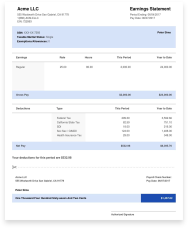
Irregular deposits are hard for a property manager to read. A monthly pay stub turns them into one familiar record: gross earnings, deductions, and net pay. Our self-employed paystub maker builds that document from your own numbers, and our pay stub templates keep the layout consistent.
Treat it as a supplement. Each stub must match your deposits and your return, and it never replaces your tax records. Whether a landlord or lender accepts one is their call, so ask first.
How to Show Proof of Income If Paid in Cash

Cash leaves no 1099 and no automatic trail. You have to build one, and our guide to proving income paid in cash goes deeper:
- Deposit cash into one business account on a set schedule.
- Log every payment with the date, client, amount, and service.
- Keep a receipt book or send receipts.
- Report all of it on Schedule C.
The return is the document that counts. Here's the plain truth: income that was never recorded or reported can't be verified, so a lender can't use it. For recurring clients, a short signed note confirming monthly payments adds support.
How Self Employed Income Verification Works
Every reviewer you'll meet does the same thing: a cross-check. The reviewer compares your documents against each other and sometimes against the IRS. Mortgage lenders commonly use Form 4506-C, the IRS's IVES transcript request, to pull your transcripts and compare them to the copies you gave them. You can see your own record first through IRS Get Transcript, so nothing surprises you.
Landlords run a simpler test. Many want gross monthly income of two to three times the rent. At $1,800 rent, that's $5,400 a month, or $64,800 a year. It's common practice, not law, so confirm each landlord's rule. In a slow month, show a 12-month average instead of one strong month.
Proof of Income Examples by Situation
Here's how to prove income when self employed in three common situations.
Renting an Apartment
A freelance designer applying as a first-time renter shows two months of bank statements, a year-to-date P&L, and last year's return. If the landlord applies a multiple-of-rent test, she adds her 12-month average.
Applying for a Mortgage
For a self-employed mortgage, a consultant with two years in business brings two years of signed returns and a year-to-date P&L. If the lender asks, he adds 12 months or more of statements. A year-over-year dip invites questions, so a short written explanation helps.
Proof of Income for a Car Loan Self-Employed Buyers Can Use
A rideshare driver financing a car typically brings recent bank statements and last year's return, plus the platform's year-end tax form. Requirements vary by lender, so ask which documents they accept before you apply. Here's how banks verify income for an auto loan.
What Business Owners Owe Their Contractors
If you hire contractors, you're on the other side of this paperwork. When your contractors work out how to prove income when self employed, the forms you send them are part of their answer. Collect a W-9 at onboarding. Issue a 1099-NEC (our 1099 generator handles the form) when payments reach the 2026 threshold of $2,000. That form is often the first document a contractor hands a landlord, so late or missing forms slow their applications.
Below the threshold, a signed payment summary from your records still helps them. Keep your own record of every payment either way.
How to Prove Income When Self Employed: Build a Packet Early
Treat documentation like payroll: a routine, not a scramble. Keep one folder with two years of returns, a year-to-date P&L, three months of statements, current 1099s, and one or two client contracts. Update it each quarter.
Follow one rule: the numbers must match. Your P&L lines up with your deposits, and any pay stubs line up with both. Mismatches are a common reason a self-employed file gets sent back.
You Might Also Like
- How to Report Freelance Income Without a 1099
- Estimate Quarterly Taxes on 1099 Income
- 1099 Tax Deductions
- W-2 and 1099: What's the Difference?
- Self-Employed Pay Stub Guide
Conclusion
Knowing how to prove income when self employed comes down to one packet, built once: tax returns, bank statements, a current P&L, and your 1099s. Keep every number consistent, and update it quarterly. If you also need a clean monthly record, a pay stub generator turns your numbers into one readable page.



Frequently Asked Questions
Similar Articles



We’ve helped numerous individuals and businesses create professional documents! Create yours today!