How to Tell if a Paystub Is Fake: 2026 Verification Guide
By Jaden Miller , October 7 2026

Here's how to tell if a paystub is fake: confirm the math reconciles, the pay dates follow a fixed cycle, and an independent source confirms the employer and the pay. No single visual flaw is proof. Generators and AI tools now produce tidy layouts with consistent arithmetic. Eyeballing a document is no longer enough. Below you'll find a side-by-side table, a ten-minute checklist, the 2026 math, and steps for landlords and lenders.
Issuing stubs for your own team? Our paystub maker builds stubs that reconcile line by line. That's exactly what a careful verifier looks for.
Key Takeaways
- Compare gross pay, taxes withheld, and net pay; the figures must reconcile to the cent.
- Round taxes are a warning sign. A round gross amount on a salaried stub is not.
- Confirm employment through a phone number you found yourself, never the one printed on the stub.
- Match the stub to bank deposits before you decide.
- Apply the same written process to every applicant.
- Real Check Stubs vs Fake: What Each One Shows
- A Fake Pay Stub Check You Can Run in 10 Minutes
- How to Tell if a Paystub Is Fake With the Math
- How to Spot a Fake ADP Pay Stub
- How Do Apartments Verify Pay Stubs?
- How Do Banks Verify Pay Stubs?
- Does a Fake Paystub Detector Work?
- Applicants Without Traditional Pay Stubs
- What to Do if a Pay Stub Looks Fake
- What Your Own Pay Stubs Need So Verifiers Trust Them
- Conclusion: How to Tell if a Paystub Is Fake
Real Check Stubs vs Fake: What Each One Shows
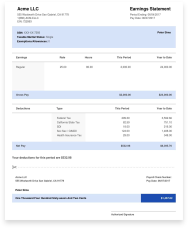
Learning how to tell if a paystub is fake starts with knowing what a real one looks like. A real stub reads like payroll output: consistent fields, exact cents, and totals that build from one pay date to the next. A fake often looks right at a glance and fails when you compare line to line. Use this table as a quick screen, and see our guide on how to read each line of a paystub if a field is unfamiliar.
| Stub element | A real stub shows | A fake often shows |
|---|---|---|
| Employer block | Legal name, full address, consistent across stubs | Missing address, or a name that changes slightly |
| Employee block | Name and job title that match the application | Leftover names or a mismatched job title |
| Pay period and pay date | A pay period that fits the cycle, with the pay date after it | Dates that skip, overlap, or fall after the application |
| Earnings | Pay rate, hours, and gross pay that multiply correctly | Totals that don't match rate times hours |
| Taxes withheld | Exact cents based on percentages and IRS tables | Round amounts, or lines missing entirely |
| Year-to-date totals | Each period adds exactly one period of gross pay | Totals that jump or reset |
| The file | An original PDF from a payroll system | A screenshot, photo, or editor-made file |
A Fake Pay Stub Check You Can Run in 10 Minutes

Run this checklist in order. It catches most problems before you spend time on calls.
Check the Document Itself
- Fonts and alignment: Mixed fonts, columns that drift, or a logo that looks pasted on suggest edits.
- Letters and numbers: The letter O in place of a zero, or swapped characters in names and addresses, points to hand typing.
- Template leftovers: Old names, a different employer, or a generic layout with no real company details.
- Missing fields: No employer address, pay period, or pay date is a gap real payroll output rarely leaves.
- Round taxes: Payroll computes taxes from percentages, so exact round-dollar tax lines look wrong. A round gross is normal for a salaried employee, for example $2,500.00 twice a month.
Check the File
Ask for the original PDF, not a photo or screenshot. Open its document properties and note the creating application and the created and modified dates. A modified date long after the pay date, or an image editor listed as the creator, is a signal worth following up. Treat it as a clue, not proof. Some legitimate portals re-save files.
How to Tell if a Paystub Is Fake With the Math
Arithmetic is the strongest test. Fakes rarely survive all of it. Gross pay minus taxes withheld minus deductions must equal net pay. Then check each tax line.
For 2026, employees pay 6.2% Social Security tax on wages up to $184,500, per the Social Security Administration, so the most it can reach is $11,439.00. Medicare is 1.45% with no cap, plus 0.9% on wages over $200,000, per IRS Topic 751. A stub that keeps taking Social Security after year-to-date wages pass the cap is wrong. Federal income tax depends on the W-4 and IRS tables. It should never be a clean percentage.
Here's a biweekly example, with no pre-tax benefits that would reduce Social Security and Medicare wages:
| Line | Amount |
|---|---|
| Gross pay | $2,200.00 |
| Social Security (6.2%) | $136.40 |
| Medicare (1.45%) | $31.90 |
| Year-to-date gross after pay date 10 | $22,000.00 |
| Annualized (26 periods) | $57,200.00 |
Annualize the gross by the pay frequency: 52 weekly, 26 biweekly, 24 semimonthly, or 12 monthly. Then compare it with the income on the application. A stub showing $2,200.00 biweekly should annualize to about $57,200, not the $80,000 the applicant reported. Pay dates should land on that same cycle every time. For the basics on these withholdings, see our explainer on FICA tax on a pay stub.
How to Spot a Fake ADP Pay Stub

ADP is among the most imitated layouts, so it earns its own checklist. ADP's enrollment guide for its pay statement portal lists the fields an employee uses to register. They are a Company Code, a File Number, a Pay Date or Advice Date, and a Check, Voucher, or Advice Number. A statement with none of those is a concern.
Next, ask the employee to show the same statement inside their ADP portal on a screen share. Genuine statements are posted there. Our overview of the ADP paystub shows what the layout looks like. We can't confirm that ADP offers a verification line for landlords, so don't assume one exists.
How Do Apartments Verify Pay Stubs?
Apartments verify pay stubs by comparing them with other records. Those include the rental application, recent bank deposits, and a call to the employer. Many property managers request two to three consecutive stubs and apply the same written process to every applicant, so no one is treated differently.
Here's the sequence that works for a small portfolio:
- Cross-check the application. Employer name, job title, start date, and stated income must match the stub.
- Match deposits. Net pay on each stub should appear as a deposit on the bank statements, on the right dates.
- Call the employer independently. Look up the number on the company's own website, never the one printed on the stub. Many employers confirm employment and dates but not pay.
- Log the result. Note what you checked, when, and who confirmed it.
Tenant screening reports can add a layer of income verification. They sit alongside these steps, not in place of them.
How to Spot Fake Pay Stubs From Your Tenants
Landlords see a few repeat patterns. Stubs dated after the application, pay dates that skip the real cycle, and net pay that never shows up as a deposit are the most common tells. Identical layouts across unrelated applicants, or an employer with no web presence, deserve a second look. Compare the employer's address on the stub with the address on its own website, and check that the stated pay rate fits the job title.
How Do Banks Verify Pay Stubs?
Banks verify pay stubs by confirming employment with the employer, matching the stub to bank deposits, and, for mortgages, comparing reported income to IRS records. Lenders can request tax return or wage transcripts only with the borrower's written consent, through an IRS program built for that purpose.
The IRS Income Verification Express Service lets borrowers authorize banks, credit unions, and other lenders to get transcripts through Form 4506-C. That is the transcript route. It differs from Form 4506, which requests a copy of a return. For auto financing specifics, read how banks verify income for an auto loan.
Does a Fake Paystub Detector Work?
A fake paystub detector can help, but it shouldn't be your only test. These tools typically check arithmetic, fonts, and file data, then flag documents that look edited. They can miss stubs with clean math and raise false alarms on scanned or re-saved files, so treat every flag as a lead.
Treat the result as one signal. Pair it with the deposit match and the employer call from the sections above. If you rely on an outside screening service, note that the FTC's consumer report rules may apply, covered below. For more on the broader process, see our guide to verifying the authenticity of a pay stub.
Applicants Without Traditional Pay Stubs
Not every honest applicant has a stub. Self-employed workers, gig workers, and new hires often can't produce one, and treating that as a red flag is a mistake.
Ask for documents that fit their situation instead:
- Self-employed or 1099: Tax returns, 1099 forms, and bank statements showing the same deposits.
- New job: A signed offer letter, plus the first stub when it arrives.
- Tips or seasonal work: A longer window of bank statements, since income varies.
Several months of deposits that line up with the tax documents tell you more than any single stub would.
What to Do if a Pay Stub Looks Fake
Once you know how to tell if a paystub is fake, the harder part is what to do next. Stay calm and document everything. Keep copies of what you received and notes on each check, then ask the applicant for the original files or another proof of income. Give them a chance to explain a discrepancy before you decide.
To stay compliant, decide on written criteria and apply them to every applicant. If a screening report played any part in a denial, the FTC says adverse action notice rules apply, even when the report was only a small factor. The notice must name the reporting agency and explain the right to dispute the report and to request a copy at no charge within 60 days. Some states and cities also protect source of income, so check local law before you set income rules.
On the applicant side, the consequences of submitting a forged stub are covered in our article on the repercussions of faking a pay stub.
What Your Own Pay Stubs Need So Verifiers Trust Them
As an employer, your stubs get checked too. Employees hand them to landlords and lenders, and a stub with missing fields or inconsistent totals can cost them an approval and cost you a stream of verification calls.
What this means for your business: every stub should show your legal name and address, the pay period and pay date, gross pay, each tax withheld, year-to-date totals, and net pay. Keep the same layout from period to period; our paystub templates make that easy. Stub rules differ by state, so confirm yours before you finalize a format. Our list of common payroll mistakes shows what to avoid.
Conclusion: How to Tell if a Paystub Is Fake
Checking whether a stub is genuine comes down to four steps: run the document check, test the math, match deposits, and confirm the employer independently. Do all four, apply them to every applicant, and write down the result.
Need accurate pay documentation for your own team? Use a reliable paystub generator to produce clean, consistent stubs in minutes.
You Might Also Like



Frequently Asked Questions
Similar Articles



We’ve helped numerous individuals and businesses create professional documents! Create yours today!